

Industrial heritage is the part of the past we choose to preserve from industry itself – buildings, machinery, stories, collections and communities that show how people worked, built and powered a region. Neville Hall in Newcastle is one of the North East’s clearest examples: a building tied to coal mining, engineering and the region’s pivotal role in powering the world.
It’s a moment when you stand on Westgate Road gazing up at Neville Hall, and you catch on: you’re not just looking at a building, you’re looking at a monument to ambition – the proud, unapologetic pride of a region that once reckoned it could power the world. The way the polychrome sandstone catches the light is a bit different every time you look, depending on the time of day – and if you squint just right, you can almost make out the ghostly outlines of the men who built it – coal owners, engineers, big thinkers who reckoned the North East’s industrial might deserved a HQ to make the London lot sit up and take notice.
That building nearly got lost forever.
Back in July 2026, Newcastle City Council stepped in at the last minute to buy Neville Hall, securing its future after the charity that looked after it, The Common Room of the Great North, ran into insurmountable financial problems. The Council’s cabinet member, Councillor Rob Austin, reckoned that it saved “a building of real architectural beauty, and some truly world-class mining stuff”. For heritage enthusiasts, historians, architects, local communities and anyone interested in Newcastle or the wider North East, Neville Hall is a super-practical example of how you preserve, restore and keep industrial heritage sites accessible. What follows tracks the building’s history, its architecture, its links to mining and engineering, the restoration led by conservation architects Howarth Litchfield, the financial hiccups that almost brought it down, the public intervention that saved it, and the ideas now being tossed around for the building’s future. In a region shaped by the Industrial Revolution, keeping places like this intact protects local culture, keeps the industrial story legible for future generations, and avoids losing it to neglect or redevelopment.
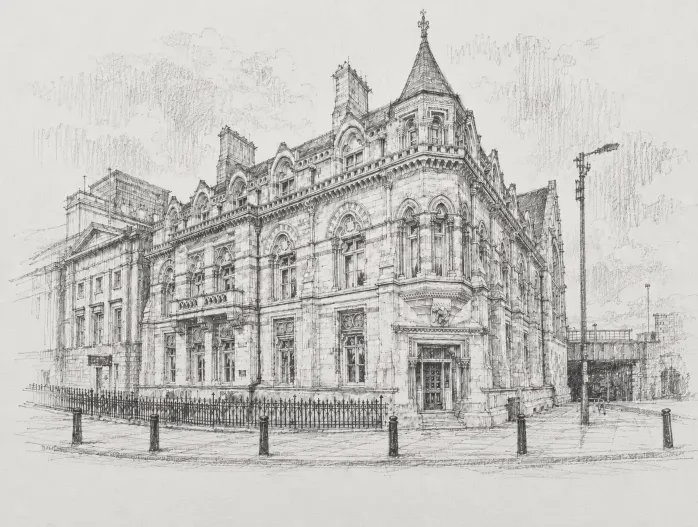
A Cathedral of Industry – The Fight to Save Industrial Heritage Sites
Neville Hall was built between ’69 and ’72 as the HQ of the North of England Institute of Mining and Mechanical Engineers (NEIMME). Industrial heritage isn’t just about old buildings – it’s about the people, the machines, the railways, and even the homes of the miners. And Neville Hall manages to capture all that in one magnificent site. The Institute itself was founded in 1852, and is still the world’s oldest big players in mining – these guys were the ones literally digging their way to the Industrial Revolution. Coal from the North East powered Britain’s factories, its navy and its empire. The Institute was where they came to swap stories, trade ideas and work out how to keep men from dying in the pits.
The building was designed by Archibald Matthias Dunn, one of the better architects working in Newcastle back in the day. He knew this building needed to say something – it needed to shout out power, permanence, and the fact it was some seriously important stuff. And guess what – he knocked it out of the park.
The list of specs for the Grade II* listing reads like the architect’s love letter to Victorian craftsmanship : polychrome sandstone with Shap granite columns at the entrance, a turret bit with a Neville symbol finial, a decorated sill band on the Orchard Street side commemorating the Institute’s founding, and an interior fit for a king – I mean a Grade II* listed building.
The inside is just as stunning as the outside – a sweeping staircase hall with a closed-string staircase, a double-height library with a barrelled vaulted roof and a skylight above, and the Wood Memorial Hall with its stained glass windows and a big stone statue of Nicholas Wood, the Institute’s first president.
The building is a monument to “Newcastle’s former days as the coal capital” and houses what’s likely the world’s most extensive mining library and the main documents to go with it. It’s no exaggeration to say that’s some seriously important stuff – the archive includes early scientific and technical reports on the development of the coal industry and associated engineering – especially early work on keeping miners alive. For a while there, its future was in doubt – and I mean really in doubt.
The Common Room Years – When Ambition Ran Headlong into Reality
In 2016, the Institute managed to get £600,000 in development cash from the Heritage Lottery Fund to kick-start the place’s redevelopment. The vision was to turn it into The Common Room of the Great North, a charity that would oversee the place and give it a new role for the 21st century. The big idea was to inspire the next bunch of innovators and engineers by using the Institute’s unique heritage as a springboard.The redevelopment of Neville Hall was a bit of a doozy. Back in 2018, the project received a further £4.1 million from the National Lottery Heritage Fund. The total bill for restoring the place came in at around £8.9 million. The whole thing was done carefully, – the exterior got a good clean, the roof got fixed, and the beautiful interior spaces were brought back as close to their former selves as possible. The Edwardian Lecture Theatre, which had been added in 1902 by Cackett and Burns Dick, was completed, and the Wood Memorial Hall – complete with its very own statue of Nicholas Wood – was returned to its former glory.
The Common Room opened its doors with all the optimism of a newly-wed. They were going to host weddings, conferences, cultural events and educational programmes – and make Neville Hall a destination, a venue, a hub, all rolled into one. ‘Self-sustaining’ was the buzz word in the heritage sector, and The Common Room was dead set on being just that.
But, as the years went by, it became clear that the money just wasn’t rolling in as they had hoped. And it wasn’t just the lack of bums on seats that was the problem – the lingering effects of the Covid lockdown had decimated the events market, and the running costs of a Grade II* listed building are just eye-wateringly expensive – heating, lighting, maintenance, insurance, staff costs. In short, the income just wasn’t covering the outgoings, and in their most recent accounts, The Common Room was running an annual deficit of a pretty frightening £128,842.
The debts started to mount – £848,000 to Newcastle City Council and a whopping £1.9 million to the North East Mayoral Authority (via the – now defunct North East Local Enterprise Partnership). It was just unsustainable. Something had to give.
The Handover: A City Centre Steps In
In July 2026, Newcastle City Council’s Cabinet made the decision to take ownership of Neville Hall. Councillor Rob Austin described it as a necessary intervention – “Sadly, running the building and servicing the debt had just outstripped the charity’s ability to bring in the dosh, so we stepped in to save it”.
As part of the deal, the massive debts were written off – and the council took ownership of the building. North East Museums – who already look after a dozen cultural venues across the region – would take over running Neville Hall, bumping up their portfolio. They’d open it up for special events, weddings, musical performances, and conferences – with the goal of making it self-sustaining. The archive – which is a real big deal – would be overseen by Tyne & Wear Archives, who are also managed by North East Museums.
It’s a classic case of the council stepping in to save a bit of civic heritage that the market just couldn’t support. And it’s not without its critics – some will argue that the taxpayer shouldn’t be bailing out a failed commercial venture, however nice the building is. Others will point out that the council’s got form in this sort of thing – Newcastle’s got a history of bailing out its most important buildings – from the Theatre Royal to the Discovery Museum.
But the counter-argument is pretty powerful – this is a Grade II* listed masterpiece, a bit of the city’s very soul – and a repository of global historical significance. Throwing in the towel and letting it fail would have been a bit of cultural vandalism. The council’s intervention means the building and its collection are safe for the future.
Matt Boyle, Chair of The Common Room’s trustees puts it well: “Neville Hall and its collection show just how much the North East contributed to building the Industrial age. Saving the building, and getting its collection out there for everyone to see, have been two of our objectives”.
The Architects Behind the Rescue: Howarth Litchfield
The story of Neville Hall’s restoration is a testament to the importance of specialist conservation architects. Howarth Litchfield Architects – an award-winning practice – were appointed after a competitive process to lead the conservation and redevelopment of Neville Hall and the Wood Memorial Hall.
The job was a big one – taking a Grade II* listed Victorian cathedral of industry and adapting it for 21st-century use, all while keeping its historic character intact. Howarth Litchfield conducted a thorough conservation survey, fixing the bits that were damaged or rotting, and came up with a plan to enhance occupant comfort without mucking up the building’s fabric. They explored loads of options to get the building up to scratch, all while keeping an eye on the building’s industrial heritage.
A clever innovation was adding a new central core within the existing open space, giving the place stairs, a lift and loo facilities – all the modern essentials that were missing before. And up on the roof, a new glass-fronted office was added, giving it a bit of a contrast with the traditional stone and slate.
Sustainability was top of the agenda too – the building now gets improved heating, lighting, and insulation, all without any damage to the historic fabric. The original roof light got a nice upgrade with thermal layering and efficient LED lighting.
The project’s excellence didn’t go unnoticed – it earned enough awards to make a whole list: shortlisted for the AJ Retrofit Listed Building Award (over £5 million) in 2023
a Highly Commended at the Civic Trust AABC Conservation Awards in 2022
winner of the RICS UK Refurbishment/Revitalisation Award 2022
and even the Lord Mayor’s Design Awards Conservation Award 2021
Neil Turner, Director at Howarth Litchfield, praised the efforts of getting everyone on board – Newcastle City Council and Historic England especially – and the big challenge of trying to find a way to make the place accessible without wrecking the heritage.
This careful balance between keeping the old and bringing in new feels like a perfect example of what it takes to conserve industrial heritage. Neville Hall now sits alongside some big hitters like Ironbridge Gorge and Zollverein Coal Mine – and we can all learn from it.
For people looking for heritage architects Newcastle, Howarth Litchfield’s work shows just how valuable it is to design something that works well for everyone – making industrial archaeology and local history as easy to get into as possible.
What’s in Store Next?
As of Autumn 2026, North East Museums will be taking over Neville Hall – reopening it for special events, weddings, concerts, and conferences. They’re also going to make the mining archive more accessible, linking up with collections at the Discovery Museum and Woodhorn Museum.
Neville Hall will be part of a whole circuit of visitor attractions – including Grainger Town with its stunning neoclassical buildings, lively nightlife, and Grainger Market (the original indoor market opened in 1835) ; plus the Quayside, where you can see all the iconic bridges and cultural venues. Visitors can explore nearby Roman fort sites and Hadrian’s Wall too – getting a glimpse of the deeper history behind the industry.
Keith Merrin, Director of North East Museums, is really excited to have Neville Hall and its archive join their collection – seeing the potential for it to be a top venue.
Running a Grade II* listed building is expensive business – but North East Museums are seasoned pros, having managed 12 cultural venues and welcoming over 800,000 visitors a year, so there’s hope for sustainability.
Neville Hall is more than just a venue, though – it’s a legacy to Newcastle’s industrial heritage and the working lives of people like its miners and shipbuilders. Set in a city shaped by coal and shipbuilding, it’s one more fantastic landmark along with Grey Street (voted England’s finest in 2005), Grey’s Monument, Newcastle Castle and the Tyne Bridge.
It’s also super easy to get around these sites thanks to good public transport. And if you’re looking for something a bit different, you can head to Ouseburn Valley with its creative spaces or Heaton Park for a change of scenery. The region’s heritage circuit extends into County Durham, Sunderland, and North Tyneside, and you can even get to York and Manchester easily by train.
You could also check out Jesmond’s stylish boutiques and restaurants, or Newcastle’s Chinatown – all of which are super easy to get to on foot or by public transport. There’s even an interactive map to help you plan your visit and link up with all these rich heritage and cultural sites – getting more people involved in the local community.
Lessons for the Future in North East England
The Neville Hall story has got a lot to teach us about heritage architecture in a place like Newcastle, which started out as a strategic settlement in the Middle Ages and grew steadily through the centuries as the industry expanded.
First off, conservation is costly – the £8.9 million restoration was a huge achievement, but running a place like this costs a fortune. Any heritage project needs a solid business plan that lasts, not just some initial funding.
Second, you need specialist expertise to pull it off. Architects like Howarth Litchfield really know their stuff – understanding the building’s fabric, knowing how to put in new services without wrecking the character, and being sensitive to what makes the building special. That’s what separates a good conservation project from a disaster.
Third, sometimes the public sector has to step in – the market isn’t always up to preserving our most precious heritage. When a building like this is at risk, the council’s intervention isn’t just warranted, it’s necessary.
And lastly, these buildings are never really finished – they change, they adapt, they find new uses. The Neville Hall that opened in 1872 was for coal owners – the one that reopens in 2026 will be for weddings and conferences and educational programmes – the building endures, but its purpose is always changing, just like the land and infrastructure reshaped by industrial expansion in the city. The Tyne Bridge, completed in 1928, is another example of how we reinvent and re-purpose buildings. That’s not failure – that’s just how heritage works.
A Building Worth Saving: Protecting Our Cultural Heritage
Standing in front of Neville Hall on Westgate Road, looking up at that beautiful polychrome sandstone facade, you can’t help but feel a sense of optimism. Neville Hall has survived all the ups and downs – financial crash, changing times, the decline of the industry that created it – and stands proud as a heritage site today. It’s survived because enough people cared – because the city council stepped in to help – because architects like Howarth Litchfield did the painstaking work of conservation.The building – it’s not just some historical monument standing there by default , it’s actually a big part of why Newcastle gets called a city forged in heavy industry, yet it still desperately wants to keep hold of the history it’s got and its name actually comes from the old new castle built in the historic heart of Newcastle, located on the river Tyne, where its strategic position helped shape the city around Newcastle Castle from medieval times. It’s a statement about what’s to come.
It’s saying we reckon our heritage is worth a bit of investment. We know that the buildings we get handed over are not ours to trash – we get to hand them down, just like the Tyne and the Tyne Bridge are still such a big part of Newcastle’s identity from the old town right up to the castle & the old castle quarter.
In Britain Neville Hall says something to the wider world about the North East, and it’s a story that matters just as much to the surrounding towns, villages, and communities across the region as it does to the city of Newcastle, where you can still see that heritage in the city’s museums, streets, parks, and green spaces today. That story stays alive in the museums, archives, and all the ongoing research that goes on. Newcastle began as a settlement whose later growth followed from its riverside position and industrial development. And it’s part of a much bigger landscape that got shaped by a royal act regulating trade and industry.
Getting exhibitions & public displays right can keep Neville Hall’s story relevant for future generations. Councillor Rob Austin put it best – “I’m really looking forward to the next bit of this lovely building’s history”