

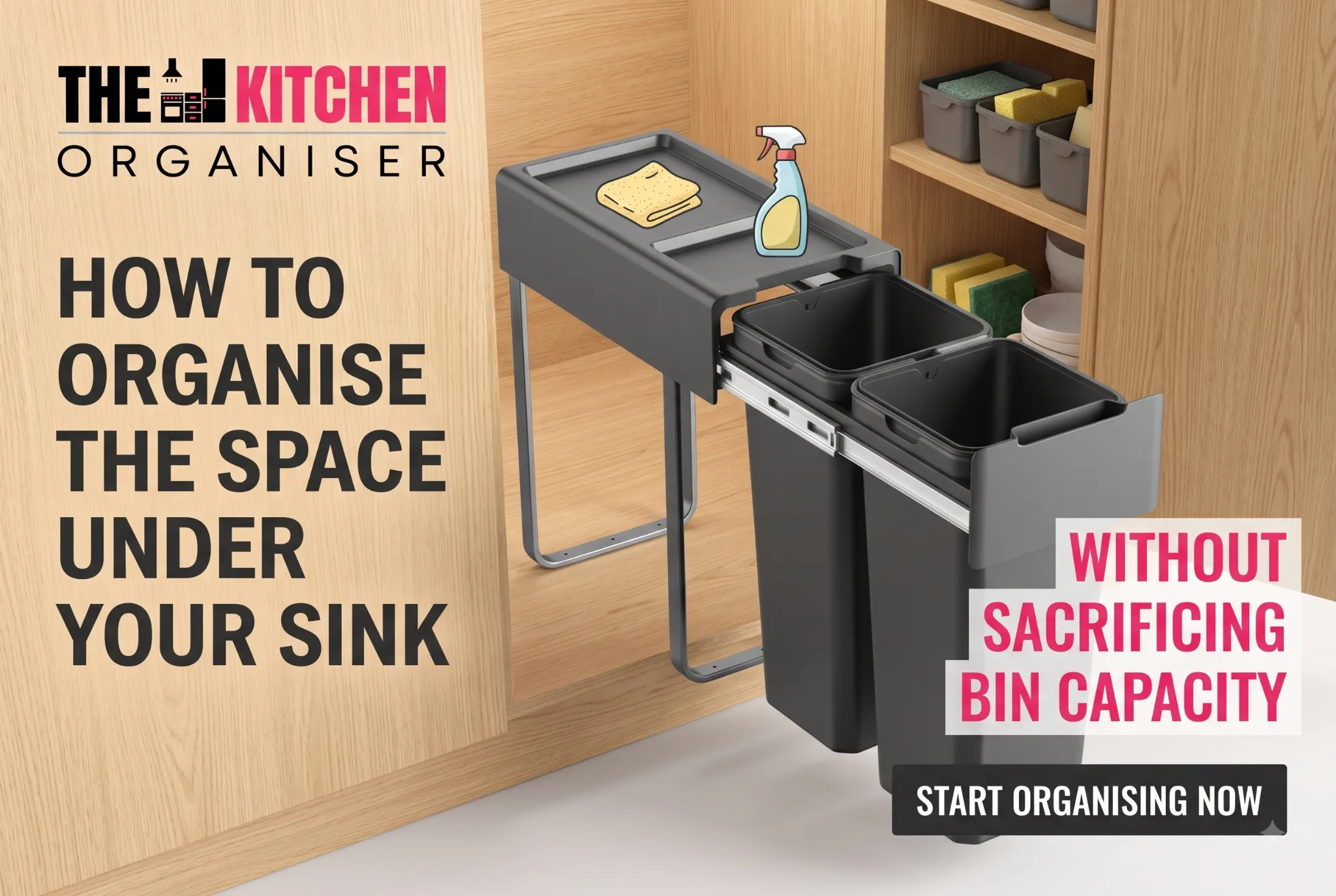
The cabinet beneath a kitchen sink often has plenty of theoretical space but surprisingly little usable space. Plumbing, the sink bowl, cleaning supplies and cabinet hinges can all interfere with storage.
A thoughtful kitchen organiser approach begins by working around those fixed obstacles instead of trying to force a standard layout into the cupboard. With accurate measurements and careful positioning, it is possible to preserve useful waste capacity while keeping the cabinet more orderly.
Measure the Cabinet Around the Plumbing
Do not rely only on the external cabinet width.
Open the doors and measure the usable interior width, depth and height. Then record where the waste pipe, water connections and sink bowl extend into that area.
The most important measurements include:
-
Clear internal width
-
Usable depth from the cabinet front
-
Height beneath the sink bowl
-
Position of plumbing pipes
-
Clearance around door hinges
-
Space required for doors to close
-
Any shelves or fixed supports
These dimensions provide a realistic picture of where a bin system can operate.
Choose Bin Position Before Organising Supplies
Cleaning products can usually be moved more easily than plumbing or a waste container. Decide first where the under sink bin can function without hitting pipework.
Under sink bin placement may work better to one side of the cupboard if the plumbing occupies the central area. In other kitchens, a lower-profile arrangement may allow useful capacity beneath the sink bowl.
Protect the Bin’s Opening Path
A bin is only convenient if it can open fully.
Test the movement, not just the dimensions
A container may physically fit inside the cabinet while still becoming difficult to use because its lid, pull-out frame or opening path hits plumbing. Consider how the bin moves during use as well as its closed dimensions.
Use Vertical Space for Smaller Items
Once the waste area is established, look for unused vertical space around it.
Cleaning cloths, dishwasher products, brushes and small bottles can often be stored in compact containers rather than spread across the cabinet floor.
Door-mounted storage may also be useful where compatible with the cabinet and bin arrangement, although care is needed to ensure stored items do not collide with internal components when the door closes.
Group Cleaning Products by Frequency
The under-sink cabinet does not need to hold every household cleaning product.
Keep frequently used kitchen supplies close to the front and move less-used products elsewhere. This prevents rarely used bottles from taking valuable space around the bin.
A simple organisation system might separate:
-
Everyday dishwashing products
-
Surface-cleaning supplies
-
Cloths and sponges
-
Waste bags
-
Occasional specialist cleaners
This leaves more uninterrupted room for functional kitchen bins.
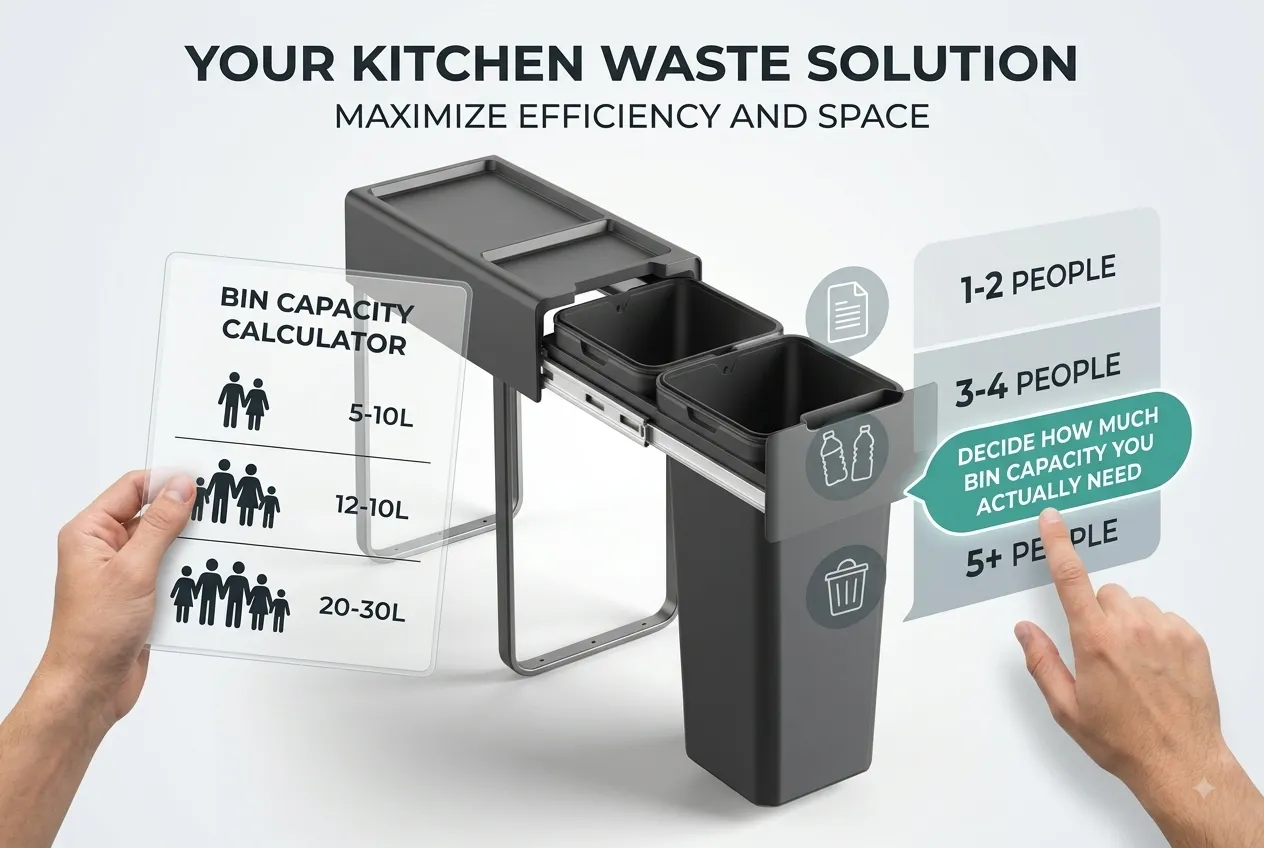
Decide How Much Bin Capacity You Actually Need
Larger is not always more convenient.
Households that empty waste frequently may prefer multiple smaller containers for separation, while others may need one larger unit.
When evaluating kitchen bins, think about household size, collection habits and recycling requirements alongside cabinet dimensions.
Kitchen bins that technically maximise litres but make the cupboard difficult to access can be less practical than a slightly smaller arrangement with better movement.
Consider a Pull-Out Configuration
Pull-out systems can make a deep cabinet easier to use because the container comes forward rather than requiring the user to reach into the cupboard.
This can be particularly useful under a sink where pipework makes the rear section awkward to access.
Check Frame and Runner Clearance
The container is only one component of a pull-out system.
Allow space for the mechanism
Measure the complete product dimensions, including runners or mounting hardware. The system must operate without contacting hinges, pipes or the cabinet door.
A kitchen organiser plan that accounts for the movement of every component is more reliable than one based solely on bin-bucket dimensions.
Keep Spare Liners Near the Waste Area
Waste bags are often stored elsewhere despite being used directly at the bin.
A narrow container or compact holder inside the cabinet can keep liners nearby without consuming much floor space. This small change can make routine bin emptying easier while keeping loose rolls from cluttering the cupboard.
Avoid Filling Every Available Gap
An organised cabinet should retain some free space.
Completely packing the area can make plumbing difficult to inspect and turn every cleaning task into a rearrangement exercise.
An under sink bin should remain easy to remove, while essential plumbing connections should remain reasonably accessible.
Why Choose Us

Kitchen Organisers provides storage and waste-management products designed to help households make better use of kitchen cabinetry. For an under-sink project, the useful starting point is not simply the biggest bin available but the relationship between the product dimensions and the cabinet layout.
This measurement-focused approach helps shoppers compare options according to their actual space.
About Us
Kitchen Organisers focuses on practical kitchen storage products, including solutions for managing waste inside cabinetry. The range can help homeowners explore layouts that keep everyday items accessible without unnecessarily occupying benchtop or floor space.
For people reorganising under-sink storage, careful measurements can help identify a more suitable balance between cleaning-supply storage and waste capacity.
Conclusion
Under-sink organisation is largely a problem of fitting movable storage around fixed obstacles. Measure the plumbing first, protect the bin’s operating space and store smaller supplies vertically or in defined groups.
The result does not have to sacrifice useful bin capacity. With the right layout, the cupboard can remain functional, accessible and considerably easier to keep organised.